Q4 2026 Construction & Real Estate: Rising Borrowing Costs and the Future of Data Center Development
Borrowing Costs Still Significant Hindrance on New Project Starts
Some construction and real estate deals are heavily contingent upon debt and borrowing, and borrowing costs have increased over the past quarter. The Federal Reserve sets the overnight borrowing costs between banks and typically affects short-term rates. The US Treasury market then often moves with the Fed, setting yield rates for longer term bonds.
The Federal Reserve is expected to hike rates at least another quarter point in December followed by as much as two more quarter point hikes in Q1 of 2027 according to current forecasts. And as those rates rise, US Treasury Rates are expected to rise with them. Bond traders typically resist geopolitical uncertainty, deficits, and inflation; all three of those are a factor given the conflicts in the Middle East and Eastern Europe. These uncertainties have pushed the 10-Year US treasury above 5.1% which in turn pushes 30-year US mortgage rates above 7.1%.
Corporate borrowing costs are also rising. Corporate bond issuances carry more risk and if an investor can get a guaranteed 5.1% in the US Treasury market, a corporate bond will have to carry a much higher yield to attract attention and entice investors to take on the extra risk. That is why some firms like CoreWeave recently had to pay more than 15% in yields to get investors to take on their debt. That then slows corporate investment and spending, if a firm raises debt instead of using cash.
The impact is evident in some of the sub-sectors of construction. Multi-family projects, single family, and nonresidential projects in some areas in manufacturing, commercial structures, office, and transportation/distribution are feeling this headwind and project starts are down Y/Y.
Looking ahead, with the Fed projected to push the overnight rate higher, Treasuries may go with them. The one catalyst that would change this relationship would be an end to one or both conflicts, or a global flight to safety for investors (which is good news for pushing US Treasury rates lower, but bad economically).
Midterms, Moratoriums, and Data Centers
The midterms ushered in a wave of local and state changes in how data centers might get built in the future. Some states and new leadership want to ban data center construction altogether, citing water, electricity, and general human welfare risks and concerns.
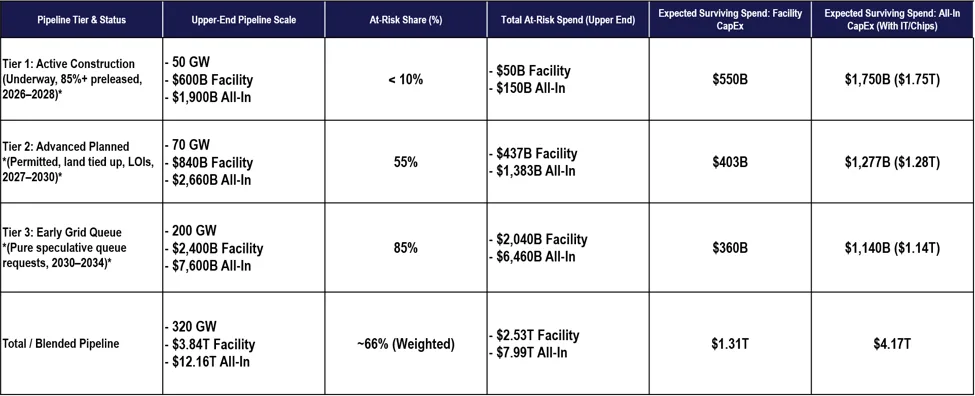
Under this new paradigm, it is believed that less than 10% of existing projects currently underway are at risk. In this ‘Tier 1’ group, more than $1.75T of all-in spending (the structure itself and the equipment that goes in it) will still be completed through 2028.
Tier 2 projects (those that are permitted, have land tied up, or have letters of intent signed) are expected to see 55% of current planned projects under pressure, delayed, or cancelled. And this pressure is not just a state-level pressure, Wall Street and bank funding for those projects are also a concern. The good news is that this still leaves an additional $1.28T in spending chasing Tier 1, stretching to 2030.
Lastly, Tier 3 projects are those that are still speculative and have not broken dirt yet. Nearly 85% of those projects are at potential risk.
All in, data center construction and facility outfitting is still expected to contribute $4.17T over the next 7 years. Given the struggles by many firms to find labor, construction materials, and the capacity to take on what was an onslaught of projects, this modest slowdown might actually be a welcome sign.













 Q4 2026 Construction & Real Estate: Rising Borrowing Costs and the Future of Data Center Development