Springline Secures Tax Credits, Generates $18.5 Million in Investment Equity to Transform Historic KC Building
Situation
Dating back to 1908, the former Westport High School in Kansas City’s Midtown area sat vacant for many years — until 2020, however, when the locally owned Park 39 development group set out to create The Residences at Park 39. The redevelopment would transform the historic building from a blighted property into an apartment community and commercial space nestled among area parks and local entertainment districts.
The new project anchors the southern portion of the Park 39 campus, a multi-phased 16-acre live-work-play campus that the development group had assembled. The Residences at Park 39 complement the earlier redevelopment of the former Westport Middle School into The Offices at Park 39, a 160,000 square-foot property that came online in 2017.
In addition to delays caused by the pandemic, however, the developers faced the challenge of securing historic tax credits to help finance the upcoming $52 million phase, part of a total $250 million redevelopment. The group turned to Springline to leverage the firm’s track record of successfully navigating these tax credits.
Solution
The team at Springline began weekly calls with the development group to gather financial data, run analyses, and create financial projections and pro forma numbers. Their team also advised on navigating recent changes to the federal historic tax credit program from the Tax Cuts and Jobs Act of 2017, as well as recent regulatory changes to the administration of the Missouri Historic Preservation Tax Credit Program. Additionally, their guidance had to account for HUD regulations relating to the project’s financing as Springline advised the development team on the intricate process of securing historic tax credits.
By running various financial models, Springline identified the best way to leverage both federal and state tax credits. While state credits are passed through on the client’s tax return, federal investors must purchase tax credits and use them to buy into the project partnership. The team also worked with the development group to run calculations for the financial impact of a sales tax exemption on construction materials that was granted by the Planned Industrial Expansion Authority of Kansas City. Springline also collaborated with local historic preservation specialists Heritage Consulting Group, which provided guidance on building rehabilitation strategies and the securing of the project’s historic tax credit approvals.
While bringing in a federal investor requires extensive underwriting and can be a rigorous process, the development group was able to close with an investor in March 2022 with Springline’s guidance. The developers began construction immediately.
Results
Despite typical construction delays and some red tape around the necessary HUD loan, Springline was able to help the developers secure the appropriate tax credits and finish construction by the end of 2023, helping them avoid tax penalties that would have been incurred after Dec. 31.
Springline also helped the developers with state reporting to properly document compliance with the incursion of qualified reimbursable expenses prior to construction completion. Toward the end of the project, Heritage stepped in and worked with Springline and the developers on various documentation issues needed to secure what were vital tax credits.
It was that thinking that generated $18.5 million in investment equity from the sale of the federal and state tax credits, realized both in 2023 (federal) and 2024 (state and federal). The development group said they appreciated the expertise Springline brought to the table, giving them the ability to leverage historic tax credits and secure sufficient funding for the project.
Chip Walsh, founder and principal of Mercier Street (co-developer on the project), emphasized that historic tax credits should never be viewed as a “handout” to the developers but as the catalyst that made the project possible in the first place.
“They are an incentive to promote the redevelopment of existing structures, rather than just tearing them down,” he said.
Andrew Brain, co-principal with Brain Group (and the other co-developer), said the credits are often the only reason historic buildings like these avoid the wrecking ball.
“Without these credits, this project would not have happened — hands down, bar none,” he said. “Because of these tax credits, there are a lot of beautiful buildings across the state that are being saved.”
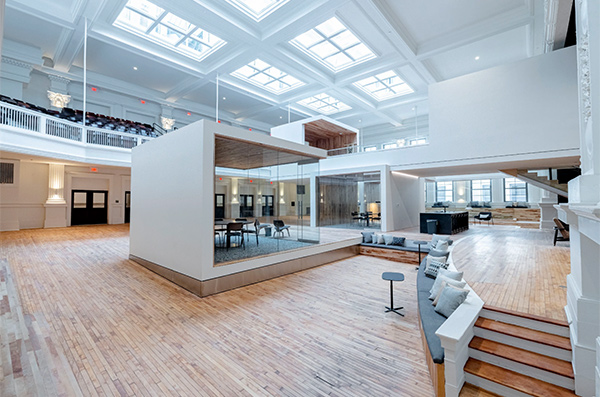
With a total of 138 units, The Residences at Park 39 is now complete and accepting applications for one- and two-bedroom and studio apartments. The redevelopment of the old high school has been described as the “perfect mix of timeless architecture and modern finishes,” as features the original entry, brick and stone façade, and hardwood floors, all complemented by modern amenities and open-concept floor plans.
The opening not only helps create additional housing in an area with limited options, but the investment is already spurring additional development in the neighborhood. The developers are currently pursuing a LEED Silver rating, and the project was recently honored with the Capstone Award for Adaptive Reuse by the Kansas City Business Journal.
“The ripple effect of a project like this,” Brain said, “cannot be underestimated.”













 Springline Secures Tax Credits, Generates $18.5 Million in Investment Equity to Transform Historic KC Building